Rare - High Quality Double Die, Beautiful Example NGC Certified
Avslutad 14 mar 17:30
Utropspris
4 000 kr
4 202 kr med köparskydd.
Auktionen avslutades utan bud
Fraktpris inom Sverige
56 kr PostNord Brevlåda
59 kr PostNord Ombud
Samfrakt
1 dag|Fri frakt över 750 krAlla betalningar granskas av Tradera för din säkerhet.








Direktbetalning | Delbetalning | Faktura
Köparskyddet gäller alla betalsätt
1/0
Beskrivning
1746 VOC – Dutch East India Company (Vereenigde Oostindische Compagnie)
Duit – Holland
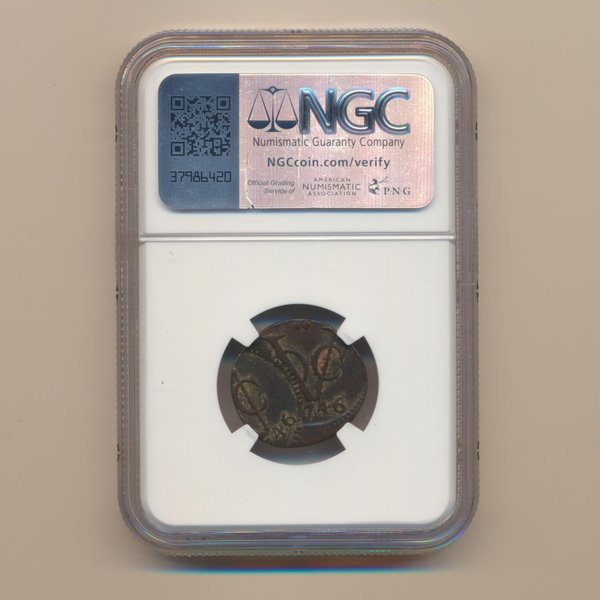
An original 1746 copper duit issued under the authority of the Dutch East India Company (VOC), struck in Holland for circulation throughout the Dutch colonial territories in the East Indies. This example has been professionally authenticated and encapsulated by NGC and carries the designation:
MINT ERROR – XF DETAILS
Double Struck – 2nd Strike Off-Center
Environmental Damage
Certification no.: 8237132-165
The coin represents a striking and highly collectible 18th-century mint error. The double strike is bold and clearly visible, with the second impression significantly off-center. As a result, major design elements appear overlapped and partially duplicated, creating a dramatic visual effect rarely encountered on early VOC copper coinage. On the obverse, the crowned shield of Holland featuring the lion rampant is visibly shifted, with portions of the shield and surrounding beaded border struck twice. On the reverse, the iconic VOC monogram is distinctly doubled, and the date 1746 appears partially replicated by the secondary strike. The misalignment between strikes allows both impressions to be studied independently, making this an excellent teaching specimen for collectors of minting errors.
The duit was a small copper denomination intended primarily for local circulation in the Dutch East Indies. These coins were shipped in vast quantities from the Dutch Republic to trading centers across modern-day Indonesia, Sri Lanka (Ceylon), South Africa (Cape Colony), and other VOC-administered regions. As a low-value transactional coin, duits typically saw heavy circulation and were often poorly preserved. Surviving examples with strong detail are desirable; pieces exhibiting major mint errors from this early period are considerably scarcer.
The 1746 issue falls within the mid-18th century phase of VOC expansion, during which the Company operated as one of the most powerful commercial enterprises in the world. The VOC monogram—formed by the intertwined letters V, O, and C—remains one of the most recognizable corporate emblems in numismatic history. Coins bearing this mark are widely collected for their historical association with global maritime trade, colonial commerce, and early corporate sovereignty.
Despite the NGC notation of environmental damage, the underlying detail remains strong and consistent with an Extremely Fine level of preservation. The crowned shield, lion, VOC monogram, and date are all clearly legible. The surfaces display natural aging typical for copper issues that circulated in tropical colonial environments, which often exposed coins to humidity and soil conditions. The encapsulation by NGC ensures long-term protection, authentication, and market recognition.
Mint errors of this magnitude on 18th-century colonial coinage are distinctly uncommon. Double-struck and off-center examples from machine-struck early modern issues are far less frequently encountered than similar errors on modern coinage. The visual impact of the overlapping shields and monograms, combined with the historical significance of VOC coinage, makes this piece particularly appealing.
A compelling acquisition for collectors of Dutch East India Company coinage, early modern world mint errors, colonial trade currency, and 18th-century copper issues. An authenticated and encapsulated example of a dramatic double-struck VOC duit from 1746, combining historical importance with technical minting interest.
Duit – Holland
An original 1746 copper duit issued under the authority of the Dutch East India Company (VOC), struck in Holland for circulation throughout the Dutch colonial territories in the East Indies. This example has been professionally authenticated and encapsulated by NGC and carries the designation:
MINT ERROR – XF DETAILS
Double Struck – 2nd Strike Off-Center
Environmental Damage
Certification no.: 8237132-165
The coin represents a striking and highly collectible 18th-century mint error. The double strike is bold and clearly visible, with the second impression significantly off-center. As a result, major design elements appear overlapped and partially duplicated, creating a dramatic visual effect rarely encountered on early VOC copper coinage. On the obverse, the crowned shield of Holland featuring the lion rampant is visibly shifted, with portions of the shield and surrounding beaded border struck twice. On the reverse, the iconic VOC monogram is distinctly doubled, and the date 1746 appears partially replicated by the secondary strike. The misalignment between strikes allows both impressions to be studied independently, making this an excellent teaching specimen for collectors of minting errors.
The duit was a small copper denomination intended primarily for local circulation in the Dutch East Indies. These coins were shipped in vast quantities from the Dutch Republic to trading centers across modern-day Indonesia, Sri Lanka (Ceylon), South Africa (Cape Colony), and other VOC-administered regions. As a low-value transactional coin, duits typically saw heavy circulation and were often poorly preserved. Surviving examples with strong detail are desirable; pieces exhibiting major mint errors from this early period are considerably scarcer.
The 1746 issue falls within the mid-18th century phase of VOC expansion, during which the Company operated as one of the most powerful commercial enterprises in the world. The VOC monogram—formed by the intertwined letters V, O, and C—remains one of the most recognizable corporate emblems in numismatic history. Coins bearing this mark are widely collected for their historical association with global maritime trade, colonial commerce, and early corporate sovereignty.
Despite the NGC notation of environmental damage, the underlying detail remains strong and consistent with an Extremely Fine level of preservation. The crowned shield, lion, VOC monogram, and date are all clearly legible. The surfaces display natural aging typical for copper issues that circulated in tropical colonial environments, which often exposed coins to humidity and soil conditions. The encapsulation by NGC ensures long-term protection, authentication, and market recognition.
Mint errors of this magnitude on 18th-century colonial coinage are distinctly uncommon. Double-struck and off-center examples from machine-struck early modern issues are far less frequently encountered than similar errors on modern coinage. The visual impact of the overlapping shields and monograms, combined with the historical significance of VOC coinage, makes this piece particularly appealing.
A compelling acquisition for collectors of Dutch East India Company coinage, early modern world mint errors, colonial trade currency, and 18th-century copper issues. An authenticated and encapsulated example of a dramatic double-struck VOC duit from 1746, combining historical importance with technical minting interest.
Köp mer och spara på frakten
Samfrakt
1 dag|Fri frakt över 750 kr Sluttid27 apr 20:12.Pris:3 000 kr,Eller Köp nu 11 000 kr,.
 Badge på objektet:NySluttid27 apr 20:34.Pris:500 kr,Eller Köp nu 2 000 kr,.


Mer för dig
Pris:.
Pris:.
Pris:.
Pris:.
Pris:.
Pris:.
Pris:.
Pris:.
Pris:.
Pris:.
Pris:.
Pris:.