1980s | SCANIA | by Wikfri AB | work jacket | photo collage lining
Slutar 30 nov 16:28
1 295 kr
Köparskydd är valfritt hos företag.
Fraktpris inom Sverige
59 kr PostNord OmbudKlimatfinansierad
Samfrakt
1 dagAlla betalningar granskas av Tradera för din säkerhet.


Direktbetalning - Delbetalning - Faktura
Köparskyddet gäller alla betalsätt
Välj till köparskydd
- Ersättning om varan inte är som beskriven
- Ersättning om du inte får din vara

1/0
Beskrivning
Vintage 1980s SCANIA Sweden Work Jacket Wikfri Ab Photo Collage Lining Estimated L made in Finland
——————
Era and identification :
Estimated production period: 1980s.
* Original SCANIA promotional / work jacket
* Manufacturer label: Wikfri Ab
* OPTI front zipper
* 70% polyester / 30% cotton
* Estimated size: L
* Made in Finland (the tag is faded, but another example of the same model found in an online archive is marked “Made in Finland”).
Another surviving example of the same SCANIA jacket design has also been documented with the Wikfri Ab manufacturer name, supporting the reading of the worn label on this example.
The construction, graphics, hardware and vehicle-photo lining are consistent with SCANIA corporate workwear from the 1980s, a decade in which the company introduced its GPRT / 2-series modular vehicle range and continued expanding its commercial-vehicle identity internationally.
——————
Material :
70% polyester
30% cotton / bomull
——————
Design :
A highly distinctive vintage SCANIA jacket built around the contrast between a restrained Scandinavian workwear exterior and an exceptionally elaborate photographic interior.
The exterior is finished in deep navy blue and constructed with a high protective collar, front zipper closure, snap-fastened storm flap and large lower utility pockets. Pale grey piping traces the shoulder structure and pocket edges, breaking up the dark body with precise geometric lines and giving the jacket a strongly technical, industrial appearance.
The chest carries a period SCANIA patch with white lettering positioned above three graduated blue blocks. The branding is relatively compact and understated compared with the interior, allowing the jacket to retain the practical visual language of professional driver and company workwear.
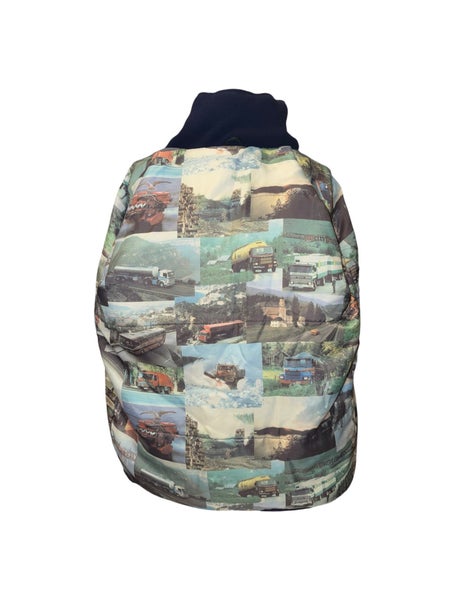
Its defining feature is the full printed lining.
Instead of conventional plain fabric, the interior is covered with a dense photographic collage devoted to SCANIA commercial vehicles. Trucks, articulated combinations, tankers, buses and specialist vehicles appear in a succession of working landscapes, including roads, forests, snow-covered environments and rural scenery.
The individual photographs run vertically through the lining and create an almost archival or catalogue-like composition. Opening the jacket transforms an otherwise sober navy work garment into a panoramic display of period SCANIA transport imagery.
The contrast is particularly effective: from the outside it reads as functional Swedish industrial clothing, while the inside functions almost as a moving corporate photo archive.
Additional construction details include the large OPTI zipper, snap closures, reinforced collar construction and hip-length silhouette associated with practical transport and occupational outerwear.
——————
Size :
Estimated size: L
Please refer to the actual measurements shown in the photos rather than the tagged size.
——————
Condition and wear :
Vintage used condition with age-related wear.
General surface wear and fading are present throughout the exterior.
The zipper pull shows noticeable loss of finish from repeated use, together with smaller signs of wear around the hardware, piping and other contact areas.
The manufacturer’s textile label is heavily worn but remains partially legible, including the wording Wikfri Ab and Sweden.
The photographic SCANIA lining remains clearly recognizable throughout and continues to display the individual vehicle scenes and landscape imagery.
——————
History :
Scania traces its industrial history to the Swedish companies Scania and Vabis, which combined in the early 20th century to form Scania-Vabis. In 1969 Scania-Vabis merged with Saab, creating Saab-Scania, and the simplified SCANIA brand name was introduced for trucks and buses.
That same year Scania introduced its 14-litre turbocharged V8 engine. The V8 became one of the defining elements of the company’s heavy-truck identity and was closely associated with the development of Scania’s low-rev, high-torque engineering philosophy.
The following decade brought a major technical transition. In 1980, Scania launched the GPRT range, commonly known as the 2-series. It was the company’s first fully modularised product range, allowing engines, chassis, cabs and other major components to be combined systematically for different transport applications.
This modular approach became fundamental to Scania’s later manufacturing strategy. During the 1980s the company’s truck and bus operations continued to expand internationally; vehicle sales increased over the decade, while new technical and research infrastructure was also developed, including the opening of the Scania Technical Centre in 1987.
Corporate clothing formed part of the broader material culture surrounding large industrial companies during this period. Work jackets, dealer garments, employee clothing and promotional apparel provided a physical extension of company identity beyond vehicles, factories and printed advertising.
This jacket is particularly notable within that context because its interior does substantially more than display a corporate logo. The photographic lining assembles numerous SCANIA vehicles into a continuous visual composition, presenting trucks and buses in the environments for which they were designed.
The surviving manufacturer’s label reads Wikfri Ab, Sweden. A separate surviving example of the same jacket design has also been listed under the Wikfri Ab name, providing independent evidence for the manufacturer identification, although detailed corporate records for Wikfri Ab have not yet been located in readily searchable online archives.
The combination of Swedish manufacture, period SCANIA branding and the unusually extensive commercial-vehicle photographic lining makes the jacket a characteristic surviving piece of Scandinavian automotive and transport-related corporate clothing from the late 20th century.
——————
Important vintage note :
This is a vintage second-hand item. Minor imperfections, slight color differences, light wear, and variations due to screen settings are natural and expected with age. These characteristics are part of the item’s history and authenticity. Post-purchase discount requests based on minor vintage traits will not be accepted. If you are looking for a perfect, mint condition item, please avoid this.
14HI-26J1
——————
Era and identification :
Estimated production period: 1980s.
* Original SCANIA promotional / work jacket
* Manufacturer label: Wikfri Ab
* OPTI front zipper
* 70% polyester / 30% cotton
* Estimated size: L
* Made in Finland (the tag is faded, but another example of the same model found in an online archive is marked “Made in Finland”).
Another surviving example of the same SCANIA jacket design has also been documented with the Wikfri Ab manufacturer name, supporting the reading of the worn label on this example.
The construction, graphics, hardware and vehicle-photo lining are consistent with SCANIA corporate workwear from the 1980s, a decade in which the company introduced its GPRT / 2-series modular vehicle range and continued expanding its commercial-vehicle identity internationally.
——————
Material :
70% polyester
30% cotton / bomull
——————
Design :
A highly distinctive vintage SCANIA jacket built around the contrast between a restrained Scandinavian workwear exterior and an exceptionally elaborate photographic interior.
The exterior is finished in deep navy blue and constructed with a high protective collar, front zipper closure, snap-fastened storm flap and large lower utility pockets. Pale grey piping traces the shoulder structure and pocket edges, breaking up the dark body with precise geometric lines and giving the jacket a strongly technical, industrial appearance.
The chest carries a period SCANIA patch with white lettering positioned above three graduated blue blocks. The branding is relatively compact and understated compared with the interior, allowing the jacket to retain the practical visual language of professional driver and company workwear.
Its defining feature is the full printed lining.
Instead of conventional plain fabric, the interior is covered with a dense photographic collage devoted to SCANIA commercial vehicles. Trucks, articulated combinations, tankers, buses and specialist vehicles appear in a succession of working landscapes, including roads, forests, snow-covered environments and rural scenery.
The individual photographs run vertically through the lining and create an almost archival or catalogue-like composition. Opening the jacket transforms an otherwise sober navy work garment into a panoramic display of period SCANIA transport imagery.
The contrast is particularly effective: from the outside it reads as functional Swedish industrial clothing, while the inside functions almost as a moving corporate photo archive.
Additional construction details include the large OPTI zipper, snap closures, reinforced collar construction and hip-length silhouette associated with practical transport and occupational outerwear.
——————
Size :
Estimated size: L
Please refer to the actual measurements shown in the photos rather than the tagged size.
——————
Condition and wear :
Vintage used condition with age-related wear.
General surface wear and fading are present throughout the exterior.
The zipper pull shows noticeable loss of finish from repeated use, together with smaller signs of wear around the hardware, piping and other contact areas.
The manufacturer’s textile label is heavily worn but remains partially legible, including the wording Wikfri Ab and Sweden.
The photographic SCANIA lining remains clearly recognizable throughout and continues to display the individual vehicle scenes and landscape imagery.
——————
History :
Scania traces its industrial history to the Swedish companies Scania and Vabis, which combined in the early 20th century to form Scania-Vabis. In 1969 Scania-Vabis merged with Saab, creating Saab-Scania, and the simplified SCANIA brand name was introduced for trucks and buses.
That same year Scania introduced its 14-litre turbocharged V8 engine. The V8 became one of the defining elements of the company’s heavy-truck identity and was closely associated with the development of Scania’s low-rev, high-torque engineering philosophy.
The following decade brought a major technical transition. In 1980, Scania launched the GPRT range, commonly known as the 2-series. It was the company’s first fully modularised product range, allowing engines, chassis, cabs and other major components to be combined systematically for different transport applications.
This modular approach became fundamental to Scania’s later manufacturing strategy. During the 1980s the company’s truck and bus operations continued to expand internationally; vehicle sales increased over the decade, while new technical and research infrastructure was also developed, including the opening of the Scania Technical Centre in 1987.
Corporate clothing formed part of the broader material culture surrounding large industrial companies during this period. Work jackets, dealer garments, employee clothing and promotional apparel provided a physical extension of company identity beyond vehicles, factories and printed advertising.
This jacket is particularly notable within that context because its interior does substantially more than display a corporate logo. The photographic lining assembles numerous SCANIA vehicles into a continuous visual composition, presenting trucks and buses in the environments for which they were designed.
The surviving manufacturer’s label reads Wikfri Ab, Sweden. A separate surviving example of the same jacket design has also been listed under the Wikfri Ab name, providing independent evidence for the manufacturer identification, although detailed corporate records for Wikfri Ab have not yet been located in readily searchable online archives.
The combination of Swedish manufacture, period SCANIA branding and the unusually extensive commercial-vehicle photographic lining makes the jacket a characteristic surviving piece of Scandinavian automotive and transport-related corporate clothing from the late 20th century.
——————
Important vintage note :
This is a vintage second-hand item. Minor imperfections, slight color differences, light wear, and variations due to screen settings are natural and expected with age. These characteristics are part of the item’s history and authenticity. Post-purchase discount requests based on minor vintage traits will not be accepted. If you are looking for a perfect, mint condition item, please avoid this.
14HI-26J1
Köp mer och spara på frakten
Samfrakt
1 dag Sluttid22:43 .Pris:1 995 kr,Köp nu.
 Sluttid16:59 .Pris:2 695 kr,Köp nu.
 Sluttid22:12 .Pris:2 495 kr,Köp nu.
 Sluttid27 okt 22:45.Pris:3 995 kr,Köp nu.
 Sluttid28 okt 13:23.Pris:695 kr,Köp nu.
 Sluttid28 okt 13:57.Pris:595 kr,Köp nu.
 Sluttid28 okt 14:17.Pris:595 kr,Köp nu.
 Sluttid28 okt 15:01.Pris:1 995 kr,Köp nu.
 Sluttid28 okt 15:44.Pris:495 kr,Köp nu.
 Sluttid28 okt 16:47.Pris:2 995 kr,Köp nu.
 Sluttid28 okt 19:25.Pris:595 kr,Köp nu.
 Sluttid28 okt 19:33.Pris:1 295 kr,Köp nu.
 Sluttid28 okt 19:34.Pris:4 495 kr,Köp nu.
 Sluttid28 okt 19:44.Pris:595 kr,Köp nu.
 Sluttid28 okt 20:24.Pris:3 995 kr,Köp nu.
 Sluttid28 okt 20:42.Pris:4 495 kr,Köp nu.
 Sluttid28 okt 21:32.Pris:6 995 kr,Köp nu.
 Sluttid28 okt 22:18.Pris:1 795 kr,Köp nu.


Andra har även tittat påVisa alla
- Pris:.
- Pris:.
- Pris:.
- Pris:.