Trench Art candelabra
Avslutad 5 aug 19:08
Utropspris
2 000 kr
2 102 kr med köparskydd.
Auktionen avslutades utan bud
Hämtas i
Alla betalningar granskas av Tradera för din säkerhet.


Direktbetalning - Delbetalning - Faktura
Köparskyddet gäller alla betalsätt
Traderas köparskydd
- Ersättning om varan inte är som beskriven
- Ersättning om du inte får din vara
1/0
Beskrivning
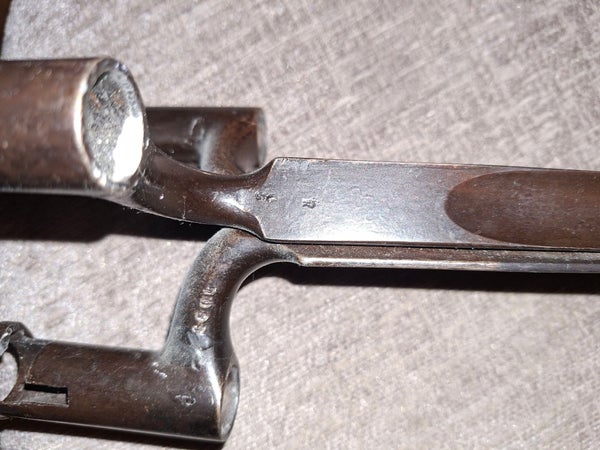
Based on the distinctive markings and design, these are Danish Model 1848 or Model 1867 socket bayonets.
The repurposing of these specific bayonets into candelabra was a common practice in the late 19th and early 20th centuries, particularly with surplus stocks from the Remington Rolling Block rifle.
Key Identification Features
The Crown over "K" Marking: This is a Danish royal property mark, typically indicating the Kronborg armory or royal acceptance.
The Script Marking: The script character (likely a "G" or "J") under the crown is an inspector's mark.
Blade Design: These have "cruciform" or triangular blades with deep fullers (grooves), which were standard for mid-to-late 19th-century socket bayonets.
Socket and Locking Ring: The cylindrical part at the top is the socket that originally fit over a rifle barrel. Some of these candelabra retain the original locking ring and tension screw used to secure the bayonet to the lug.
Historical Context
The bayonets likely originated from one of two Danish rifle systems:
M1848 "Tapriffel": A pillar-breech rifle used during the Schleswig-Holstein Wars.
M1867 Remington Rolling Block: Denmark adopted this rifle in 11.7mm caliber; when these rifles became obsolete, large quantities of their bayonets were sold as surplus and frequently converted into decorative household items like these.
Serial Numbers: The stamped numbers (e.g., 4503, 2306) are weapon serial numbers, as Danish bayonets were individually fitted and numbered to match a specific rifle.
Unit Markings: Some stamps on the shank or socket may indicate the specific infantry battalion or company the bayonet was assigned to before its "retirement" into a candelabra.
Obs: item description by Gemini A.I.
I can not garentee authenticity of description.
Check pictures carefully so you know what you are bidding on.
No returns.
Items can be picked up in Uppsala.