Sweden 25 Öre 1937
Slutar 1 nov 16:56
Utropspris
100 kr
107 kr med köparskydd.
Fraktpris inom Sverige
64 kr PostNord Brevlåda
Samfrakt
1 dag|Fri frakt över 750 krAlla betalningar granskas av Tradera för din säkerhet.


Direktbetalning - Delbetalning - Faktura
Köparskyddet gäller alla betalsätt
1/0
Beskrivning
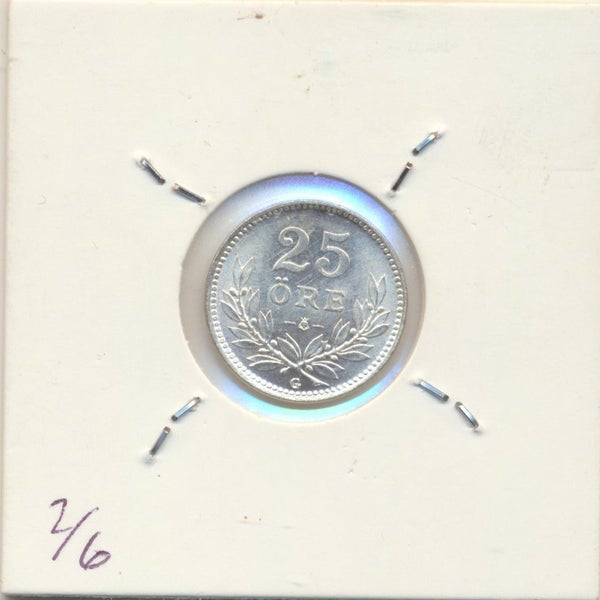
Sweden – 1937 G – 25 Öre – King Gustaf V – Silver Coin – Historic Swedish Three Crowns – Scandinavian Numismatics
An attractive historic Swedish silver coin, struck in 1937 during the reign of King Gustaf V, representing the final years of Europe's interwar period and the remarkable transformation of Sweden into a modern industrial nation.
Offered here is a 1937 Swedish 25 Öre silver coin, produced at the Royal Swedish Mint during the reign of King Gustaf V (1907–1950). Featuring the historic Three Crowns of Sweden, the royal crown, and a traditional Scandinavian wreath, this classic twentieth-century coin combines national symbolism, royal heritage, and genuine silver content.
The coin belongs to an important period in Swedish monetary history, when silver remained an everyday component of circulating currency and the Swedish krona was firmly established as the nation's monetary unit.
Sweden in 1937 – A Nation Between Two World Wars
The year 1937 was a fascinating period in Swedish and European history.
Europe was experiencing growing political tensions as the continent moved toward the outbreak of the Second World War in 1939. While many European nations were preparing for conflict, Sweden continued to develop its policy of neutrality and strengthen its industrial economy.
During this period, Sweden was undergoing significant social and economic changes. Manufacturing, engineering, forestry, mining, and international trade were becoming increasingly important to the country's prosperity.
Major Swedish industrial enterprises such as Volvo, SKF, Ericsson, and ASEA were contributing to Sweden's reputation for engineering excellence and technological innovation.
The Swedish welfare state was also beginning to take shape. The Social Democratic government led by Prime Minister Per Albin Hansson promoted the concept of Folkhemmet, or "the People's Home," envisioning a society characterized by greater economic security and social cooperation.
This 1937 silver coin was struck during precisely this transformative period, making it a tangible reminder of Sweden's development during the years preceding the Second World War.
King Gustaf V – Sweden's Long-Reigning Monarch
King Gustaf V reigned over Sweden from 1907 until his death in 1950, making his reign one of the longest in modern Swedish history.
Born in 1858, Gustaf V witnessed extraordinary political, technological, and social changes throughout his lifetime.
His reign encompassed the First World War, the Great Depression, the Second World War, and the emergence of Sweden as a modern constitutional monarchy.
Unlike many earlier Swedish monarchs, Gustaf V ruled during a period when royal political authority was increasingly limited and parliamentary democracy became firmly established.
In 1937, the king was 79 years old and had already occupied the Swedish throne for three decades.
Coins issued during his reign are popular among collectors of Scandinavian royal coinage, European monarchies, and historic Swedish silver currency.
The Three Crowns – Sweden's Ancient Royal Symbol
One of the most historically significant features of this coin is the crowned shield displaying the famous Three Crowns of Sweden, known in Swedish as Tre Kronor.
The Three Crowns have represented Sweden for centuries and remain among the country's most recognizable national symbols.
Their use can be traced to medieval Swedish heraldry, particularly during the fourteenth century. The emblem became firmly associated with the Swedish monarchy and later developed into one of the principal symbols of the Swedish state.
The three golden crowns on a blue background form Sweden's lesser national coat of arms.
Throughout history, the symbol has appeared on royal seals, military standards, government buildings, official documents, and Swedish coinage.
Today, the Three Crowns are internationally recognized through their continued use in Swedish heraldry and national sporting traditions.
The design on this 1937 coin preserves a heraldic tradition stretching back hundreds of years.
The Historic 25 Öre Denomination
The Swedish krona and öre monetary system was introduced in 1873 as part of the Scandinavian Monetary Union, which originally connected the monetary systems of Sweden and Denmark, with Norway joining in 1875.
Under this system, one krona was divided into 100 öre.
The 25 öre denomination therefore represented one quarter of a Swedish krona and was an important part of everyday commerce.
Silver 25 öre coins circulated widely throughout Sweden and were used for ordinary purchases during a time when even relatively small monetary denominations retained meaningful purchasing power.
The 1937 issue belongs to Sweden's earlier silver coinage tradition, before the significant changes in coinage composition that followed during the twentieth century.
Traditional Scandinavian Coin Design
The coin features a restrained and elegant design characteristic of Swedish coinage during the reign of Gustaf V.
One side displays the denomination 25 ÖRE, prominently positioned above a decorative wreath. Below the denomination appears a small central symbol, with the mintmaster's initial G positioned at the bottom.
The opposite side features the crowned Swedish national shield bearing the Three Crowns, accompanied by the date 1937, divided between the left and right sides of the coat of arms.
The inscription SVERIGE, meaning Sweden, appears beneath the shield.
The combination of the royal crown, heraldic shield, traditional wreath, and carefully balanced typography gives the coin a distinctly Scandinavian appearance.
Its design reflects the understated elegance and strong national symbolism of Swedish coinage from the early twentieth century.
The Royal Swedish Mint and the G Mintmaster Initial
The coin was struck in Stockholm at the Royal Swedish Mint, known historically as Kungliga Myntverket.
The letter G identifies mintmaster Alf Grabe, who served during this period.
Swedish coins traditionally carried small letters or symbols identifying the mintmaster responsible for production, providing an additional element of historical interest for numismatic collectors.
The 1937 issue is therefore identifiable not only by its denomination and date, but also by its connection to a specific period of Swedish mint administration.
Specifications
Country: Sweden (Sverige)
Denomination: 25 Öre
Year: 1937
Köp mer och spara på frakten
Samfrakt
1 dag|Fri frakt över 750 kr Badge på objektet:NySluttid31 okt 16:11.Pris:100 kr,Eller Köp nu 540 kr,.
 Badge på objektet:NySluttid2 nov 01:30.Pris:560 kr,Utropspris.
 Badge på objektet:NySluttid2 nov 01:32.Pris:800 kr,Utropspris.
 Badge på objektet:NySluttid2 nov 01:32.Pris:60 kr,Utropspris.
 Badge på objektet:NySluttid2 nov 01:33.Pris:101 kr,Utropspris.
 Badge på objektet:NySluttid2 nov 14:57.Pris:400 kr,Utropspris.


Andra har även tittat påVisa alla
- Pris:.
- Pris:.
- Pris:.
- Pris:.