As-is | antique | Sangi Dagger | Mindanao Philippines | blade 15cm
Slutar 3 nov 20:35
∙21 h 21 min
1 295 kr
Köparskydd är valfritt hos företag.
Fraktpris inom Sverige
56 kr PostNord OmbudKlimatfinansierad
Samfrakt
1 dagAlla betalningar granskas av Tradera för din säkerhet.


Direktbetalning
Köparskyddet gäller alla betalsätt
Välj till köparskydd
- Ersättning om varan inte är som beskriven
- Ersättning om du inte får din vara
1/0
Beskrivning
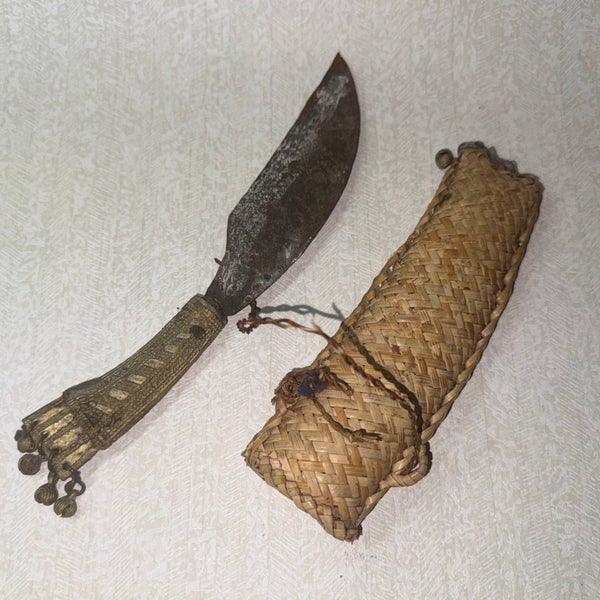
Antique Sangi Dagger – Mindanao Philippines – Brass Hilt & Woven Scabbard with Bells
——————
Era and identification :
Estimated production period: late 19th to early 20th century.
Traditional Sangi / Sangngi dagger or utility knife, associated with the indigenous metalworking traditions of Mindanao in the southern Philippines.
The form is particularly associated with groups including the Bagobo, T’boli and neighboring peoples of Mindanao.
* Curved single-edged blade
* Decorated cast brass hilt
* Multiple suspended brass bells
* Woven plant-fiber scabbard with additional bells
* Maker: Unknown
* Exact place and date of manufacture: Unknown
——————
Material :
Iron or steel blade with cast brass hilt and decorative fittings.
The scabbard is constructed from woven natural plant fiber, likely rattan or a related material, with twisted fiber suspension cords and metal bell ornaments.
——————
Design :
A particularly characterful example of a traditional Mindanao knife, combining a functional curved blade with elaborate indigenous metalwork.
The blade has a broad, asymmetric profile, widening through the body before sweeping toward a pointed tip. Its surface now carries extensive oxidation, dark patination and areas of old surface loss.
The hilt is considerably more decorative. It is covered by textured brass work arranged in geometric bands, with contrasting raised elements running along the grip. Several small suspended bells hang from the terminal end, giving the knife the ornamental quality strongly associated with traditional southern Philippine metalwork.
The fitted woven scabbard is almost as visually distinctive as the knife itself. Narrow strips of plant material have been woven into a dense herringbone-like pattern and finished with braided edges. Small metal bells are suspended from one end, while twisted fiber cords remain attached around the body.
The combination of aged iron, darkened brass and naturally aged woven fiber gives the entire piece an exceptionally strong ethnographic appearance.
——————
Size :
Blade length: approximately 15 cm.
Please refer to the actual measurements shown in the photos for dimensions.
——————
Condition and wear :
Antique condition with extensive age-related wear.
The blade has substantial oxidation, corrosion, discoloration and surface deposits. The brass components show oxidation, darkening, verdigris and general surface wear.
The woven scabbard has age-related wear, staining, loosened and damaged fibers, and deterioration to some of the cords and attachments.
One bell appears to be missing from the scabbard.
No restoration or polishing has been carried out. The aged surface and patina have intentionally been left as found.
——————
History :
The Sangi, also encountered under spellings such as Sangngi, belongs to the diverse edged-tool traditions of Mindanao, an island with a particularly rich history of indigenous blacksmithing, brass casting, weaving and personal ornament.
Unlike the larger swords for which the southern Philippines are perhaps better known among arms collectors, knives of this general form were practical objects. They could serve as everyday cutting implements for agricultural work, preparing plant material, food and other routine tasks. The distinction between tool, personal possession and ornament was not necessarily as rigid as it is in modern Western cutlery: an everyday object could simultaneously display the metalworking and decorative traditions of its community.
The brass work is therefore an important part of the object. Communities of southern Mindanao developed sophisticated traditions of casting and decorating brass objects, including jewelry, containers, dress ornaments and the fittings of edged tools. Geometric surface decoration and suspended bells occur across a range of Mindanao material culture.
Small bells were particularly prominent in the dress and ornament of peoples such as the Bagobo and T’boli. They could be incorporated into clothing, jewelry, containers and other personal objects, producing both visual ornament and sound as the wearer moved. Here that decorative vocabulary continues onto both the hilt and woven scabbard.
The scabbard is also significant. Rather than merely protecting the blade, its tightly woven plant-fiber construction demonstrates another important craft tradition of the region. The juxtaposition of forged iron, cast brass and woven organic material makes pieces of this type especially interesting as ethnographic objects because several distinct craft disciplines survive together in a single utilitarian object.
Examples of traditional Mindanao weapons and tools entered European and American collections particularly during the late 19th and early 20th centuries, a period when material culture from the Philippines was increasingly collected by travelers, colonial officials, ethnographers and museums. The exact history of this particular example is unknown, but its construction and extensive age-related patination are consistent with an old ethnographic piece rather than a modern decorative knife.
——————
Important vintage note :
This is a vintage second-hand item. Minor imperfections, slight color differences, light wear, and variations due to screen settings are natural and expected with age. These characteristics are part of the item’s history and authenticity. Post-purchase discount requests based on minor vintage traits will not be accepted. If you are looking for a perfect, mint condition item, please avoid this.
rm-26I4
——————
Era and identification :
Estimated production period: late 19th to early 20th century.
Traditional Sangi / Sangngi dagger or utility knife, associated with the indigenous metalworking traditions of Mindanao in the southern Philippines.
The form is particularly associated with groups including the Bagobo, T’boli and neighboring peoples of Mindanao.
* Curved single-edged blade
* Decorated cast brass hilt
* Multiple suspended brass bells
* Woven plant-fiber scabbard with additional bells
* Maker: Unknown
* Exact place and date of manufacture: Unknown
——————
Material :
Iron or steel blade with cast brass hilt and decorative fittings.
The scabbard is constructed from woven natural plant fiber, likely rattan or a related material, with twisted fiber suspension cords and metal bell ornaments.
——————
Design :
A particularly characterful example of a traditional Mindanao knife, combining a functional curved blade with elaborate indigenous metalwork.
The blade has a broad, asymmetric profile, widening through the body before sweeping toward a pointed tip. Its surface now carries extensive oxidation, dark patination and areas of old surface loss.
The hilt is considerably more decorative. It is covered by textured brass work arranged in geometric bands, with contrasting raised elements running along the grip. Several small suspended bells hang from the terminal end, giving the knife the ornamental quality strongly associated with traditional southern Philippine metalwork.
The fitted woven scabbard is almost as visually distinctive as the knife itself. Narrow strips of plant material have been woven into a dense herringbone-like pattern and finished with braided edges. Small metal bells are suspended from one end, while twisted fiber cords remain attached around the body.
The combination of aged iron, darkened brass and naturally aged woven fiber gives the entire piece an exceptionally strong ethnographic appearance.
——————
Size :
Blade length: approximately 15 cm.
Please refer to the actual measurements shown in the photos for dimensions.
——————
Condition and wear :
Antique condition with extensive age-related wear.
The blade has substantial oxidation, corrosion, discoloration and surface deposits. The brass components show oxidation, darkening, verdigris and general surface wear.
The woven scabbard has age-related wear, staining, loosened and damaged fibers, and deterioration to some of the cords and attachments.
One bell appears to be missing from the scabbard.
No restoration or polishing has been carried out. The aged surface and patina have intentionally been left as found.
——————
History :
The Sangi, also encountered under spellings such as Sangngi, belongs to the diverse edged-tool traditions of Mindanao, an island with a particularly rich history of indigenous blacksmithing, brass casting, weaving and personal ornament.
Unlike the larger swords for which the southern Philippines are perhaps better known among arms collectors, knives of this general form were practical objects. They could serve as everyday cutting implements for agricultural work, preparing plant material, food and other routine tasks. The distinction between tool, personal possession and ornament was not necessarily as rigid as it is in modern Western cutlery: an everyday object could simultaneously display the metalworking and decorative traditions of its community.
The brass work is therefore an important part of the object. Communities of southern Mindanao developed sophisticated traditions of casting and decorating brass objects, including jewelry, containers, dress ornaments and the fittings of edged tools. Geometric surface decoration and suspended bells occur across a range of Mindanao material culture.
Small bells were particularly prominent in the dress and ornament of peoples such as the Bagobo and T’boli. They could be incorporated into clothing, jewelry, containers and other personal objects, producing both visual ornament and sound as the wearer moved. Here that decorative vocabulary continues onto both the hilt and woven scabbard.
The scabbard is also significant. Rather than merely protecting the blade, its tightly woven plant-fiber construction demonstrates another important craft tradition of the region. The juxtaposition of forged iron, cast brass and woven organic material makes pieces of this type especially interesting as ethnographic objects because several distinct craft disciplines survive together in a single utilitarian object.
Examples of traditional Mindanao weapons and tools entered European and American collections particularly during the late 19th and early 20th centuries, a period when material culture from the Philippines was increasingly collected by travelers, colonial officials, ethnographers and museums. The exact history of this particular example is unknown, but its construction and extensive age-related patination are consistent with an old ethnographic piece rather than a modern decorative knife.
——————
Important vintage note :
This is a vintage second-hand item. Minor imperfections, slight color differences, light wear, and variations due to screen settings are natural and expected with age. These characteristics are part of the item’s history and authenticity. Post-purchase discount requests based on minor vintage traits will not be accepted. If you are looking for a perfect, mint condition item, please avoid this.
rm-26I4
Köp mer och spara på frakten
Samfrakt
1 dag Sluttid04:15 .Pris:2 495 kr,Köp nu.
 Sluttid07:34 .Pris:1 495 kr,Köp nu.
 Sluttid12:41 .Pris:1 295 kr,Köp nu.
 Sluttid17:37 .Pris:995 kr,Köp nu.
 Sluttid19:05 .Pris:1 695 kr,Köp nu.
 Sluttid19:25 .Pris:695 kr,Köp nu.
 Sluttid19:47 .Pris:2 695 kr,Köp nu.
 Sluttid21:17 .Pris:3 595 kr,Köp nu.
 Sluttid23:11 .Pris:995 kr,Köp nu.
 Sluttid3 nov 23:20.Pris:1 495 kr,Köp nu.
 Sluttid3 nov 23:37.Pris:1 495 kr,Köp nu.
 Sluttid4 nov 09:18.Pris:595 kr,Köp nu.
 Sluttid4 nov 09:50.Pris:495 kr,Köp nu.
 Sluttid4 nov 16:04.Pris:495 kr,Köp nu.


Andra har även tittat påVisa alla
- Pris:.
- Pris:.
- Pris:.
- Pris:.