Collection of 12 Swedish historical currency pieces
Slutar 3 dec 12:00
Utropspris
350 kr
370 kr med köparskydd.
Fraktpris inom Sverige
64 kr PostNord Brevlåda
64 kr PostNord
Traderas spårbara frakt är klimatfinansierad!
Samfrakt
1 dag|Fri frakt över 750 krAlla betalningar granskas av Tradera för din säkerhet.


Direktbetalning - Delbetalning - Faktura
Köparskyddet gäller alla betalsätt
Traderas köparskydd
- Ersättning om varan inte är som beskriven
- Ersättning om du inte får din vara
1/0

Beskrivning
Sweden – Collection of 12 Antique Copper Coins – 1634–1847 – Swedish Royal Coinage, Öre, Skilling & Skilling Banco
A Historical Collection Spanning More Than Two Centuries of Swedish Coinage
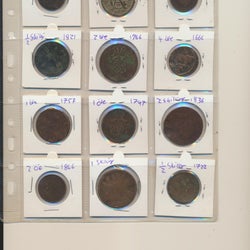
An interesting collection of 12 historical Swedish copper coins, dating from 1634 to 1847 and representing more than 200 years of Scandinavian monetary history.This assortment includes coins issued during the reigns of Queen Christina, Charles XI, Gustav IV Adolf, Charles XIII, Charles XIV John, and Oscar I, offering a broad overview of the development of Swedish currency from the seventeenth century through the middle of the nineteenth century.
The collection features several traditional Swedish denominations, including 1/4 öre, 1/6 öre, 1/12 skilling, 1/4 skilling, 1/2 skilling, and 2 skilling banco.
Of particular historical interest are the two seventeenth-century copper coins, dated 1634 and 1666, which originate from the period when Sweden was emerging as one of the most influential military and political powers in Northern Europe.
The remaining pieces illustrate the development of Sweden's increasingly complex monetary system during the Napoleonic era and the establishment of the Bernadotte dynasty.
Together, these coins represent a tangible connection to Swedish economic history, royal succession, early modern European warfare, and the evolution of Scandinavian commerce.
Coins Included in the Collection
The collection consists of the following 12 coins, identified according to the visible designs and handwritten collection labels:- 2 Skilling Banco – 1847: Oscar I (1844–1859). A larger copper denomination from the final decades of Sweden's pre-decimal monetary system.
- 1/12 Skilling – 1803: Gustav IV Adolf (1792–1809). Small copper denomination produced during the Napoleonic era.
- 1/2 Skilling – 1821: Charles XIV John (1818–1844). Swedish copper coin featuring traditional national symbolism.
- 1/4 Skilling – 1807: Gustav IV Adolf (1792–1809). Copper coin issued shortly before the Finnish War.
- 1/12 Skilling – 1812: Charles XIII (1809–1818). Small-denomination coin from a period of political transition.
- 1/12 Skilling – 1812: Charles XIII (1809–1818). A second example of this denomination and date.
- 1/4 Öre – 1634: Queen Christina (1632–1654). Early seventeenth-century Swedish copper coin, traditionally known as a fyrk.
- 1/6 Öre – 1666: Charles XI (1660–1697). Seventeenth-century Swedish copper coin associated with the country's expanding monetary economy.
- 1/2 Skilling – 1826: Charles XIV John (1818–1844).
- 1/4 Skilling – 1825: Charles XIV John (1818–1844).
- 1/2 Skilling – 1829: Charles XIV John (1818–1844).
- 1/2 Skilling Riksgälds – 1799: Gustav IV Adolf (1792–1809). An interesting copper monetary token issued by the Swedish National Debt Office.
The coins are arranged individually in cardboard holders within a transparent numismatic storage page.
Sweden in the Seventeenth Century – The Rise of a European Power
During the seventeenth century, Sweden experienced one of the most remarkable periods of expansion in its history.Under the leadership of Gustavus Adolphus and his successors, Sweden developed into a formidable military power with extensive territories surrounding the Baltic Sea.
The kingdom played a central role in the Thirty Years' War, an extraordinarily destructive conflict that transformed the political and religious landscape of Central Europe.
Swedish military victories, expanding international trade, and the development of the country's substantial mineral resources contributed to the kingdom's growing economic importance.
Copper was particularly significant.
Sweden possessed some of Europe's most productive copper deposits, especially those associated with the Great Copper Mountain at Falun.
The metal became a major export commodity and an important foundation of the national economy.
Unlike many European states, where lower-value coins were predominantly produced from silver or billon, Sweden developed an unusually extensive copper currency system.
This reflected both the availability of domestic copper and the government's desire to use the country's mineral wealth as a foundation for its monetary system.
The earliest two coins in this collection, dated 1634 and 1666, originate from this distinctive period of Swedish history.
Queen Christina – The 1/4 Öre of 1634
The oldest coin in the collection is a Swedish 1/4 öre dated 1634, issued during the reign of Queen Christina.Christina became Queen of Sweden in 1632 following the death of her father, Gustavus Adolphus, at the Battle of Lützen during the Thirty Years' War.
As Christina was only a child when she inherited the throne, Sweden was initially governed by a regency council led by influential statesmen, including Chancellor Axel Oxenstierna.
The kingdom continued its military involvement in Germany while maintaining its position as an important European power.
The 1634 copper 1/4 öre was produced during this regency period.
The denomination was commonly known as a fyrk, a traditional Swedish monetary term associated with a quarter of an öre.
These coins were produced in considerable quantities and played an important role in everyday commercial transactions.
The design incorporates traditional Swedish heraldic imagery, including the crowned Vasa shield and the Three Crowns emblem.
The coin's age makes it a particularly interesting addition to the assortment, representing Swedish monetary history nearly four centuries ago.
Queen Christina would later become one of Sweden's most remarkable historical figures. Her decision to abdicate in 1654, convert to Catholicism, and relocate to Rome attracted enormous attention throughout Europe.
The 1634 coin therefore provides a connection to the early reign of one of the most unconventional monarchs in Swedish history.
Köp mer och spara på frakten
Samfrakt
1 dag|Fri frakt över 750 kr Sluttid2 dec 12:01.Pris:121 kr,Utropspris.
 Sluttid2 dec 12:02.Pris:162 kr,Utropspris.
 Sluttid2 dec 22:06.Pris:30 kr,Utropspris.
 Sluttid3 dec 12:04.Pris:352 kr,Utropspris.


- Pris:.
- Pris:.
- Pris:.
- Pris:.