British Empire & Canada – Collection of 4 Historic One Cent Coins – 1876–1918
Slutar 4 dec 15:44
Utropspris
40 kr
44 kr med köparskydd.
Fraktpris inom Sverige
27 kr Annat fraktsättSäljaren erbjuder ett alternativt fraktsätt. Vänligen se objektsbeskrivningen för mer info.
64 kr PostNord Brevlåda
64 kr PostNord
Traderas spårbara frakt är klimatfinansierad!
Samfrakt
1 dag|Fri frakt över 750 krAlla betalningar granskas av Tradera för din säkerhet.


Direktbetalning - Delbetalning - Faktura
Köparskyddet gäller alla betalsätt
Traderas köparskydd
- Ersättning om varan inte är som beskriven
- Ersättning om du inte får din vara
1/0
Beskrivning
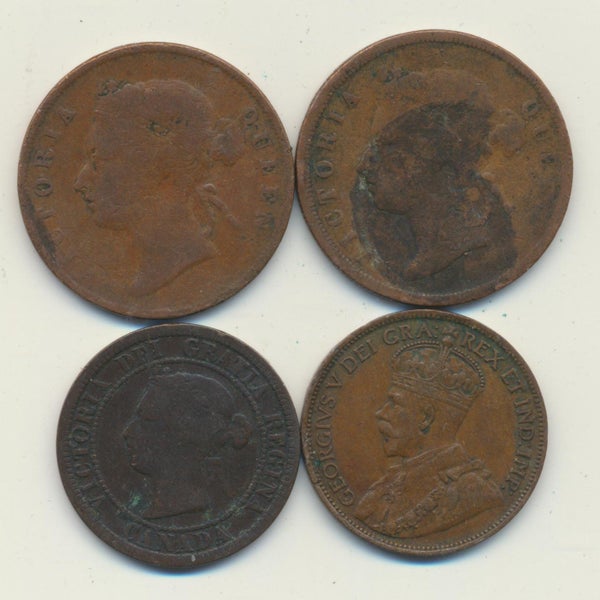
British Empire & Canada – Collection of 4 Historic One Cent Coins – 1876–1918 – Queen Victoria, Edward VII & George V – Colonial Copper Coinage
A fascinating collection of four historic copper coins from the British Empire and Canada, spanning the Victorian era, the Edwardian period, and the First World War. Featuring three British monarchs, this assortment represents more than four decades of royal history, Canadian development, and the extraordinary transformation of the British Empire.
Offered here is a collection of four historical one-cent coins, featuring issues from British Straits Settlements and Canada. The coins date from 1876 to 1918, representing an era when the British Empire extended across much of the globe and its currency circulated through an enormous network of colonies, territories, and trading ports.
The collection includes coins bearing the portraits of Queen Victoria, King Edward VII, and King George V, three monarchs whose reigns encompassed the height of British imperial power and the beginning of its transformation in the twentieth century.
The Four Coins in This Collection
1. British Straits Settlements – 1900 – 1 Cent – Queen Victoria
Issued during the final years of Queen Victoria's reign, this colonial copper coin originates from the Straits Settlements, a group of strategically important British territories in Southeast Asia.
The Straits Settlements included Singapore, Penang, and Malacca, which became major centers of international commerce.
The coin displays the portrait of Queen Victoria on one side and the denomination ONE CENT with the inscription STRAITS SETTLEMENTS and the year 1900 on the other.
Struck only one year before Victoria's death in 1901, this coin represents the closing chapter of the Victorian era.
2. British Straits Settlements – 1899 – 1 Cent – Queen Victoria
Another fascinating example of British colonial coinage from Southeast Asia, issued during the reign of Queen Victoria.
Like the 1900 issue, this coin reflects the extensive commercial influence of the British Empire in the region and the importance of Singapore and the surrounding settlements to international maritime trade.
The denomination and date are visibly worn, illustrating the long history of handling and circulation associated with colonial copper currency.
3. Canada – 1876 – 1 Cent – Queen Victoria
A nineteenth-century Canadian copper cent dating to 1876, only nine years after Canadian Confederation in 1867.
The coin features Queen Victoria on the obverse, surrounded by the royal inscription, and the denomination ONE CENT within a decorative wreath on the reverse.
During this period, Canada was still a relatively young Dominion within the British Empire, developing its national institutions, expanding its railway network, and establishing its economic identity.
This coin represents an early chapter in Canadian national currency and the reign of one of history's most influential monarchs.
4. Canada – 1918 – 1 Cent – King George V
A Canadian one-cent coin issued during the final year of the First World War.
The obverse features the crowned portrait of King George V, while the reverse displays the denomination ONE CENT CANADA 1918, surrounded by an elegant wreath of maple leaves.
The maple leaf had already become an important Canadian national symbol and continues to appear on Canadian coinage today.
This coin was issued during a pivotal year in Canadian history, when Canadian soldiers were fighting in Europe and the country was emerging with an increasingly distinct national identity.
Queen Victoria – The Monarch of an Empire
Queen Victoria reigned from 1837 until 1901, presiding over an era of extraordinary industrial, technological, economic, and imperial expansion.
During her reign, Britain became the world's leading industrial and maritime power, while its empire expanded across Asia, Africa, the Americas, and the Pacific.
The Victorian period witnessed the development of railways, steamships, telegraph networks, modern banking institutions, and international trade on an unprecedented scale.
British currency circulated throughout the empire, providing a common connection between territories separated by thousands of kilometers.
The coins in this collection bearing Queen Victoria's portrait reflect this immense imperial network.
From the trading ports of Singapore to the emerging Canadian Dominion, her likeness served as a symbol of British sovereignty.
The Straits Settlements – Britain's Gateway to Asia
The Straits Settlements occupied one of the most strategically important commercial regions in the world.
Situated along maritime routes connecting the Indian Ocean with the South China Sea, the settlements played a central role in trade between Europe, India, China, and Southeast Asia.
Singapore rapidly developed into an international trading port after its establishment as a British trading settlement in 1819.
By the late nineteenth century, ships carrying tea, spices, textiles, tin, rubber, and numerous other commodities regularly passed through the region.
The Straits Settlements became a Crown Colony in 1867, placing them under direct British administration.
Their distinctive coinage was an essential part of local commerce and reflected the interaction between British imperial institutions and the diverse populations of Southeast Asia.
The 1899 and 1900 copper cents offered in this collection were issued during the final years of Queen Victoria's reign, when British influence in the region was firmly established.
Today, historic Straits Settlements coins are collected by enthusiasts of Singaporean, Malaysian, Southeast Asian, and British colonial numismatics.
Canada – From Confederation to a Modern Nation
Canada entered a new political era in 1867 with the creation of the Dominion of Canada.
The original federation united Ontario, Quebec, Nova Scotia, and New Brunswick, laying the foundation for the modern Canadian state.
During the following decades, Canada expanded westward, developed its transportation infrastructure, and experienced significant economic and demographic growth.
Köp mer och spara på frakten
Samfrakt
1 dag|Fri frakt över 750 kr Sluttid4 dec 12:41.Pris:81 kr,Utropspris.
 Sluttid4 dec 12:42.Pris:81 kr,Utropspris.
 Sluttid4 dec 12:42.Pris:81 kr,Utropspris.
 Sluttid4 dec 12:42.Pris:54 kr,Utropspris.


- Pris:.
- Pris:.
- Pris:.
- Pris:.